
.png)
Growing a restaurant business requires careful planning and strategic thinking. While the desire to expand might feel overwhelming, there are several proven paths that restaurant owners can explore to scale their operations effectively. Understanding these 5 expansion paths for restaurant owners can help you make informed decisions about your business's future without overcommitting resources or taking unnecessary risks.
The restaurant industry offers multiple avenues for growth, each with its own advantages and considerations. From opening additional locations to diversifying service offerings, successful expansion often depends on choosing the right strategy that aligns with your current capabilities and market opportunities.
Opening Second Locations and Multi-Unit Development
Opening a second location is one of the most capital-intensive ways to expand. Startup costs typically range from $180,000 to $800,000, with the average coming in around $275,000 for a leased space. And that's before you account for working capital to cover the first few months while revenue at the new location is still building.
- Market analysis is crucial before selecting new locations. Look for areas where your existing customer base is underserved, not just high foot traffic.
- Start with nearby markets to maintain operational oversight during the initial phase. Managing quality across locations gets harder the farther apart they are.
- Your management systems need to be solid before you expand. If your current location still depends heavily on you being present, a second location will stretch you thin fast.
- Plan your financing early. Many restaurant owners use an SBA loan for larger build-out costs and a merchant cash advance for the working capital gap in the first few months of operation.
A merchant cash advance can be particularly useful for the working capital side because approval is fast and repayment is tied to your daily sales volume, so you are not locked into a fixed monthly payment while the new location is still ramping up. See how much you qualify for →
Developing New Menu Verticals and Service Offerings
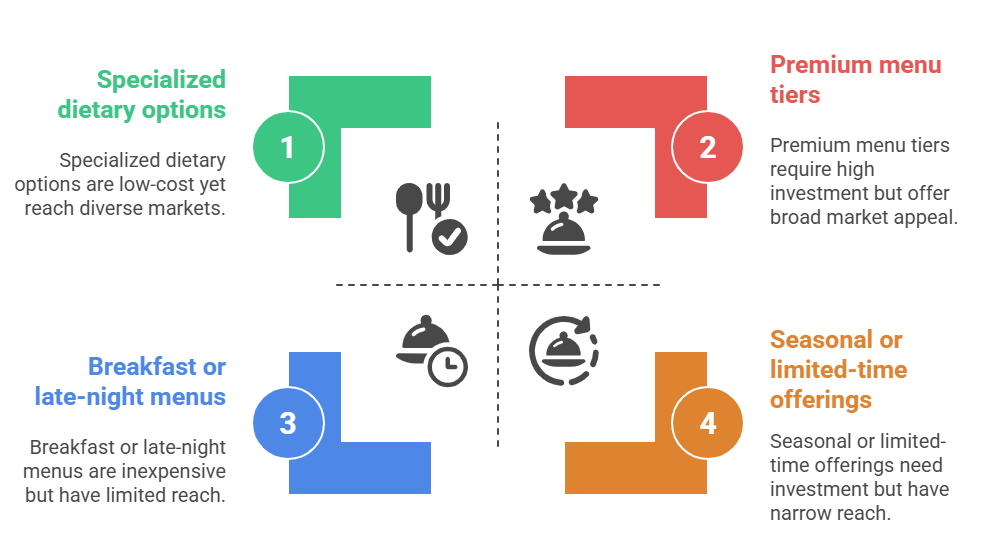
New menu verticals are one of the lowest-risk ways to grow because they do not require a new space or a major capital commitment upfront. Adding a breakfast menu, a late-night offering, or a specialized dietary line can open up new customer segments without touching your existing operations.
That said, some menu expansions do require investment. New equipment, updated POS configurations, additional staff training, and marketing for the new offering all add up. The key is testing before committing. A limited-time menu addition or a seasonal item lets you gauge demand before investing in permanent changes.
- Breakfast or late-night menus can extend operating hours and capture customer segments you are currently missing.
- Specialized dietary options like vegan, gluten-free, or keto-friendly items can attract health-conscious diners who might otherwise skip your restaurant.
- Seasonal or limited-time offerings create urgency and encourage repeat visits from existing customers.
- Premium menu tiers with higher-end ingredients or more elaborate preparation can increase your average ticket size without requiring more customers.
If equipment upgrades are needed to support a new menu direction, a merchant cash advance can cover those costs quickly, with repayment scaling alongside your revenue. Check your eligibility in 30 seconds →
Expanding Into Catering Services
For restaurants that already have an established kitchen and culinary team, catering is one of the most natural and cost-effective expansion paths. Typical startup costs for adding catering range from $10,000 to $50,000, covering equipment like warming trays and transport containers, licensing, and initial marketing, which is far less than opening a new location.
- Corporate catering contracts provide steady, predictable revenue that complements the variability of dine-in service.
- Wedding and special event catering typically carries higher profit margins and can significantly boost monthly revenue during peak seasons.
- Delivery logistics and equipment require upfront investment in transport, packaging, and warming equipment.
- Staff scheduling becomes more flexible since catering events often happen during off-peak hours for your restaurant.
The startup costs here are manageable enough that many restaurant owners fund their catering launch through a short-term merchant cash advance, paying it back through the steady revenue that catering contracts bring in. See what you qualify for →
Implementing Online Delivery and Digital Expansion
Digital expansion has become one of the most accessible growth paths for restaurant owners. The entry point can be as simple as listing on a third-party delivery platform, or as involved as launching a ghost kitchen concept.
The average cost to open a ghost kitchen that operates from a single location is between $20,000 and $60,000, significantly lower than a traditional second location. Ghost kitchens also tend to generate average profit margins of around 15%, driven by lower overhead since there is no front-of-house staff or dine-in space to maintain.
- Third-party delivery platforms like DoorDash and Uber Eats can expand your reach quickly, though commission fees typically run 15 to 30 percent per order.
- Ghost kitchens or delivery-only concepts let you test new markets or menu ideas with significantly less capital than a new storefront.
- Mobile ordering and loyalty apps improve customer convenience while giving you data on ordering patterns and preferences.
- Social media becomes your storefront for digital expansion, especially if you are running a delivery-only concept without a physical sign.
For restaurant owners who want to launch a ghost kitchen or invest in digital ordering infrastructure, a merchant cash advance provides fast access to capital without the lengthy approval process of a traditional loan. Get started here →
Steps to Choose Your Restaurant Expansion Strategy

Choosing your restaurant expansion strategy requires careful evaluation of your current situation, resources, and market conditions. These steps can help guide your decision-making process effectively.
- Assess your current financial position and determine how much capital you can realistically invest in expansion without jeopardizing your existing operations
- Analyze your local market conditions to identify opportunities and potential challenges that might influence which expansion path makes the most sense
- Evaluate your operational capacity including staff capabilities, management systems, and kitchen efficiency to determine which growth strategies align with your strengths
- Start with low-risk testing such as pop-up experiences or limited-time menu additions before committing to larger expansion investments
- Develop clear success metrics for measuring the effectiveness of your chosen expansion strategy and be prepared to adjust your approach based on results
Remember that successful restaurant expansion doesn't always require choosing just one path. Many successful restaurant owners grow their operations by combining multiple strategies, such as adding catering services while also developing online delivery capabilities, to create diverse revenue streams that support sustainable growth.
Steps to Choose Your Restaurant Expansion Strategy
Choosing your restaurant expansion strategy requires careful evaluation of your current situation, resources, and market conditions. These steps can help guide your decision-making process effectively.
- Assess your current financial position and determine how much capital you can realistically invest in expansion without jeopardizing your existing operations.
- Analyze your local market conditions to identify opportunities and potential challenges that might influence which expansion path makes the most sense.
- Evaluate your operational capacity including staff capabilities, management systems, and kitchen efficiency to determine which growth strategies align with your strengths.
- Start with low-risk testing such as pop-up experiences or limited-time menu additions before committing to larger expansion investments.
- Develop clear success metrics for measuring the effectiveness of your chosen expansion strategy and be prepared to adjust your approach based on results.
One factor that often gets overlooked in this process is financing. Many restaurant owners wait until they are ready to expand before thinking about funding, but understanding your options early gives you more flexibility when the right opportunity comes up. Whether you need working capital to cover the first few months at a new location or a short-term cash injection to launch a catering operation, knowing what you qualify for ahead of time puts you in a much stronger position to move quickly. See your funding options →
Growing your restaurant business through strategic expansion can open new opportunities for increased revenue and market presence. Whether you choose to open second locations, develop new menu verticals, expand into catering services, implement online delivery, or combine multiple approaches, success typically depends on thorough planning and realistic assessment of your capabilities.
Each expansion path offers unique advantages and challenges, making it important to choose strategies that align with your current resources and long-term business goals. Starting with lower-risk options like menu diversification or catering services can help you build experience and confidence before pursuing more capital-intensive growth strategies.
.svg)