.png)

How to Calculate Your Repayment Amount for Merchant Cash Advances
Understanding how to calculate your repayment amount is crucial when considering a merchant cash advance for your business. Many business owners find themselves confused by factor rates and daily deductions, but the calculation process doesn't have to be complicated. With the right knowledge of the factor rate formula and understanding of daily deduction structures, you can accurately estimate your total payback amount before committing to any financing agreement.
This comprehensive guide will walk you through the essential steps and formulas needed to determine exactly what you'll pay back, helping you make informed decisions about your business financing needs.
Understanding the Factor Rate Formula
The factor rate formula serves as the foundation for calculating your merchant cash advance repayment amount. This straightforward calculation method helps business owners determine their total financial obligation upfront.
- Basic multiplication method: Multiply your advance amount by the factor rate to get your total repayment figure
- Factor rate ranges: These typically fall between 1.1 and 1.5, meaning you might pay back 10% to 50% more than the original advance
- Fixed cost structure: Unlike traditional interest rates, factor rates remain constant throughout the repayment period
- Transparency benefits: This method provides clear visibility into your total financial commitment from day one
The factor rate formula's simplicity makes it easier for merchants to budget effectively and understand exactly what they're agreeing to pay. This transparency can help you compare different financing options and choose the most suitable arrangement for your business needs.
Calculating Daily Deduction Amounts
Daily deduction calculations help you understand how your repayment amount gets collected over time through your regular business transactions. This method typically ties your repayment schedule directly to your daily sales volume.
- Percentage-based collections: Most providers collect a fixed percentage of your daily credit card sales, usually between 10% and 20%
- Variable payment structure: Your daily payments fluctuate based on your business performance, providing flexibility during slower periods
- Revenue tracking requirements: Accurate sales reporting becomes essential for proper deduction calculations
- Cash flow impact: Understanding daily deductions helps you predict how the advance might affect your operating capital
The daily deduction method can provide breathing room during slower business periods, as your payments automatically adjust to match your revenue flow. This feature often makes merchant cash advances more manageable than traditional fixed-payment financing options.
Creating Your Total Payback Estimate
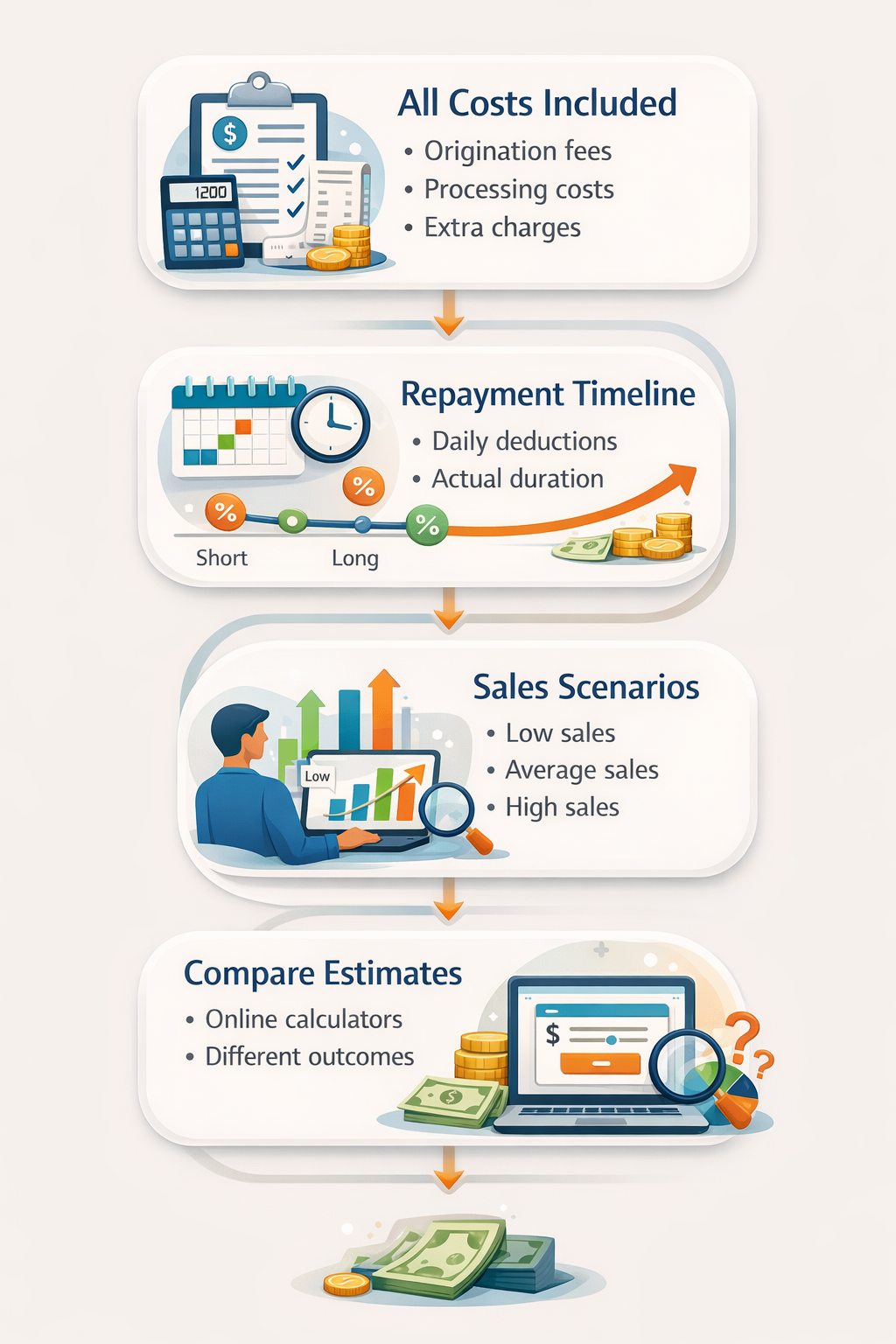
Your total payback estimate combines the factor rate calculation with an understanding of fees and collection methods to give you a complete picture of your financial commitment.
- All-inclusive calculation: Include origination fees, processing costs, and any additional charges in your total estimate
- Timeline considerations: Factor in how daily deduction percentages might affect the actual repayment duration
- Scenario planning: Calculate estimates based on different sales volume projections to understand various outcomes
- Cost comparison tools: Use online calculators to verify your manual calculations and explore different scenarios
Creating accurate total payback estimates requires considering both the mathematical formula and the practical aspects of how payments get collected. This comprehensive approach helps you avoid surprises and ensures your business can handle the financial obligations throughout the entire repayment period.
Common Calculation Mistakes to Avoid
Even with straightforward formulas, business owners sometimes make errors when calculating their repayment amounts. Being aware of these common pitfalls can help you achieve more accurate estimates.
- Overlooking additional fees: Failing to include origination fees, processing charges, or other costs in your total calculation
- Misunderstanding factor rates: Confusing factor rates with annual percentage rates or traditional interest calculations
- Ignoring payment frequency: Not accounting for how daily collections might extend or shorten your actual repayment timeline
- Unrealistic revenue projections: Basing calculations on overly optimistic or pessimistic sales forecasts
Taking time to double-check your calculations and understand all components of your merchant cash advance agreement can save you from costly misunderstandings. Many providers offer calculators or assistance to help verify your estimates and ensure you have realistic expectations about your repayment obligations.
Steps for Accurate Repayment Planning
Following a systematic approach to repayment planning helps ensure you can meet your obligations while maintaining healthy cash flow for daily operations.
- Gather complete terms: Collect all details about factor rates, fees, and collection percentages before starting your calculations
- Calculate total payback: Use the factor rate formula to determine your complete financial obligation
- Estimate daily collections: Project how much will be deducted from your daily sales based on the agreed percentage
- Create payment timeline: Estimate how long repayment might take based on your typical sales volume
- Build financial cushion: Plan for potential sales fluctuations that could affect your ability to maintain operations
Proper repayment planning involves more than just understanding the mathematics. You need to consider how the daily deductions will impact your ability to pay suppliers, cover payroll, and handle unexpected expenses throughout the repayment period.
Mastering how to calculate your repayment amount puts you in control of your merchant cash advance decision. The factor rate formula provides the foundation, while understanding daily deductions and total payback estimates helps you plan effectively for the future.
Remember that accurate calculations require considering all fees, realistic revenue projections, and the practical impact of daily collections on your cash flow. Taking time to understand these elements thoroughly can help you choose financing that supports your business growth rather than creating financial strain.
When you're ready to explore merchant cash advance options, having this calculation knowledge will empower you to negotiate better terms and make confident decisions about your business financing needs.