.png)

Choosing the right funding option for your business isn't just about how much money you can access. It's about understanding how you'll pay it back. Real repayment scenarios across different funding types vary dramatically, and what works for one business might create cash flow problems for another. A company with steady, predictable revenue might thrive with fixed monthly payments, while a seasonal business could struggle under the same structure.
The three most common funding types, SBA loans, lines of credit, and revenue-based financing, each come with distinct repayment models. Understanding these differences helps you align your financing choice with your actual cash flow patterns rather than forcing your business to adapt to an incompatible payment schedule. Let's break down how repayment works in practice across these popular funding options.
How SBA Loans Structure Repayment
How SBA loans structure repayment sets them apart as a long-term financing solution. These government-backed options typically offer larger amounts with lower interest rates compared to many alternatives, making them attractive for substantial business investments.
- Fixed monthly payments: SBA loans operate on a predetermined schedule where you pay the same amount each month regardless of your sales performance. This predictability helps with budgeting but requires consistent cash flow to meet obligations.
- Extended repayment terms: Many SBA loans offer repayment periods stretching from 10 to 25 years, which keeps individual payments manageable even for significant funding amounts. This structure works well for acquisitions, real estate purchases, or major equipment investments.
- Lower interest costs over time: Because SBA loans often feature competitive interest rates, the total cost of borrowing may be less than other options, provided you can handle the fixed payment schedule through varying business cycles.
- Strict qualification requirements: The favorable terms come with rigorous approval processes and documentation needs, which might delay access to funds compared to more flexible financing types.
For businesses with stable, predictable revenue streams, this repayment model offers an efficient way to fund long-term growth initiatives without the higher costs associated with short-term or variable financing.
Business Lines of Credit and Revolving Repayment
Business lines of credit and revolving repayment provide a fundamentally different approach to financing. Instead of receiving a lump sum, you gain access to a credit limit you can draw from as needed.
- Pay only on what you use: Unlike traditional financing where you receive the full amount upfront and pay interest on everything, lines of credit charge interest only on the portion you've actually borrowed. This flexibility can reduce costs during periods when you need less capital.
- Revolving access: As you repay what you've borrowed, that credit becomes available again without reapplying. This makes lines of credit particularly useful for managing recurring expenses or bridging short-term cash flow gaps.
- Variable payment amounts: Your monthly payment changes based on how much you've drawn and repaid, which requires careful tracking but offers adaptability that fixed payments can't match.
- Ideal for working capital needs: Businesses often use lines of credit to cover inventory purchases, seasonal fluctuations, or unexpected opportunities that require quick access to funds without the commitment of a larger, fixed-repayment product.
This repayment structure works best when you need financial flexibility to handle irregular expenses or want to maintain a financial cushion without paying for capital you're not actively using.
Revenue-Based Financing and Performance-Linked Payments
Revenue-based financing and performance-linked payments create a repayment model that fluctuates with your actual sales. This approach offers unique advantages for businesses with variable or seasonal revenue patterns.
- Payments tied to sales volume: Instead of owing a fixed amount each month, your payment adjusts based on your monthly revenue. When sales are strong, you pay more. When business slows, your obligation decreases proportionally.
- Protection during slow periods: This structure helps businesses avoid the financial strain that can occur when fixed payments come due during lower-revenue months, reducing the risk of default or cash flow problems.
- Faster repayment during growth: When your business performs well, you'll pay back the financing more quickly. This means you might pay more in total compared to a fixed-rate option, but you gain flexibility that can be worth the premium.
- Alignment with business rhythm: For companies with inconsistent cash flow, fluctuating customer demand, or seasonal peaks and valleys, revenue-based financing allows debt service to naturally align with the business's financial reality rather than imposing an arbitrary payment schedule.
This repayment approach tends to appeal to merchants who value cash flow management flexibility over minimizing total interest costs, particularly those in industries with inherent revenue variability.
Comparing Real Repayment Scenarios Across Different Funding Types
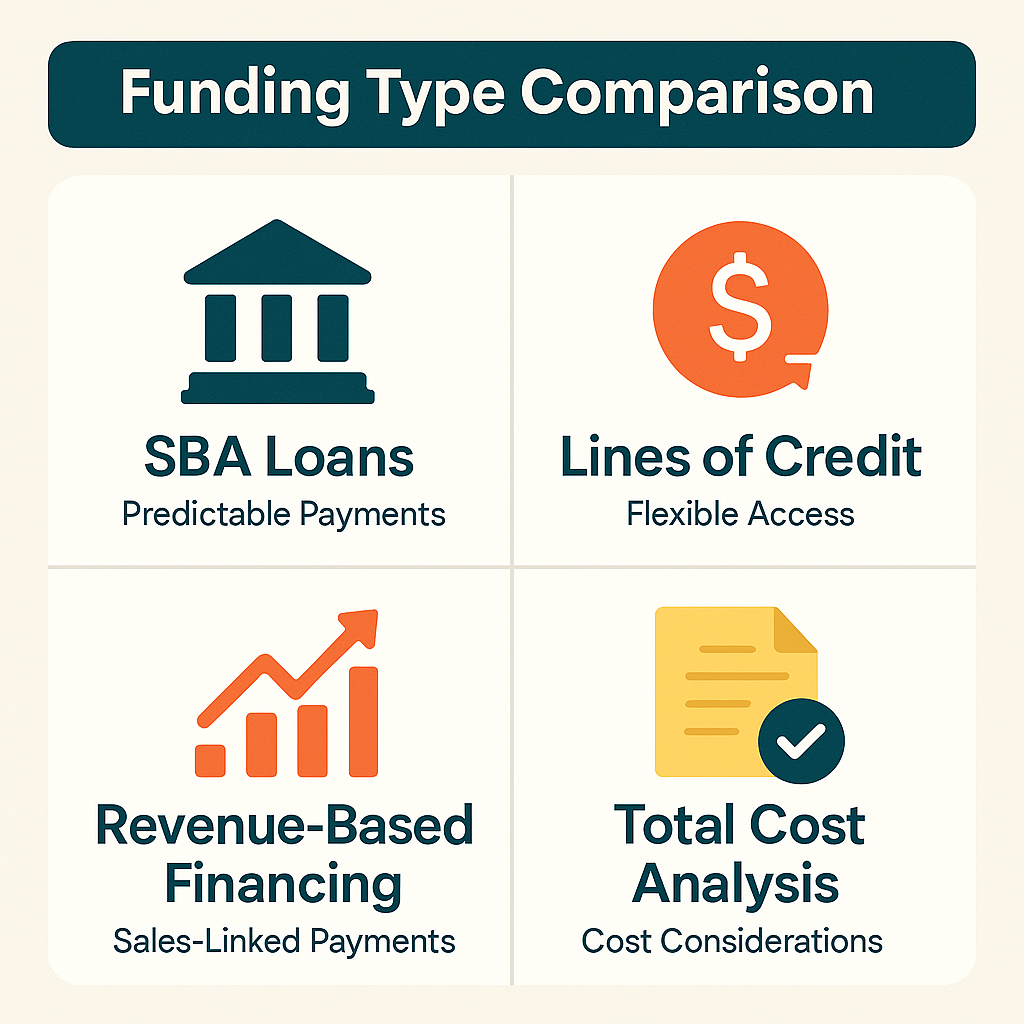
Comparing real repayment scenarios across different funding types reveals how the same business might experience dramatically different financial outcomes depending on which option they choose.
- Predictability versus flexibility: SBA loans offer the most predictable payment schedule, which benefits financial planning but requires consistent revenue. Lines of credit provide middle-ground flexibility, while revenue-based financing offers maximum adaptability to changing sales patterns.
- Total cost considerations: SBA loans typically feature lower interest rates and may cost less over the full repayment period. Revenue-based financing might carry higher effective rates but could prevent costly cash flow problems that fixed payments sometimes create.
- Access and approval differences: Lines of credit and revenue-based financing generally have faster approval processes and less stringent qualification requirements than SBA loans, which can matter when timing is critical for capturing business opportunities.
- Use case alignment: Long-term investments like real estate or acquisitions often align better with SBA loan structures, while inventory management suits lines of credit, and businesses with variable revenue may find revenue-based options more manageable.
The right choice depends less on which option is objectively better and more on which repayment structure matches your specific cash flow patterns, growth plans, and risk tolerance.
Making the Right Repayment Choice for Your Business
Making the right repayment choice for your business requires honest assessment of your financial situation and operational realities. Here's a practical approach to matching funding types with your needs.
- Analyze your cash flow patterns: Review at least 12 months of revenue data to identify whether your income is steady, seasonal, or unpredictable. Businesses with consistent monthly revenue can typically handle fixed payments, while those with significant fluctuations might benefit from flexible repayment structures.
- Define your funding purpose: Determine whether you need financing for a specific large purchase, ongoing working capital, or growth that will increase revenue over time. This clarity helps narrow which funding types align with your actual business objectives.
- Calculate your repayment capacity: Be realistic about what you can afford during your slowest months, not just your average or peak periods. This conservative approach helps prevent taking on payment obligations you can't sustain through natural business cycles.
- Consider your timeline and urgency: If you need funding quickly for a time-sensitive opportunity, options with faster approval processes might outweigh products with slightly better terms but longer qualification periods.
- Evaluate total cost versus cash flow impact: Sometimes paying a bit more in total interest or fees makes sense if it prevents cash flow problems that could damage vendor relationships, limit inventory, or force you to miss growth opportunities.
By working through these considerations systematically, you can identify which repayment structures supports your business operations rather than creating unnecessary financial pressure.
Understanding real repayment scenarios across different funding types empowers you to make financing decisions based on how payments will actually affect your day-to-day operations. SBA loans, lines of credit, and revenue-based financing each serve different business needs, and the best choice depends on your specific cash flow patterns, growth plans, and risk tolerance.
The key isn't finding the cheapest option or the one with the most favorable marketing. It's about matching the repayment structure to your business rhythm so that financing supports your growth rather than constraining it. Take time to honestly assess your revenue patterns, define your funding purpose, and choose the option that works with your business, not against it.