
.png)

Business owners often face a critical question when considering external capital: will this funding actually move the needle? It's tempting to think that more money automatically equals more growth, but that's not always the case. Before you commit to any financing option, you need a clear framework to evaluate whether it makes sense for your specific situation.
Understanding how to determine if funding will actually help your business starts with honest assessment. You'll want to look at the numbers, sure, but also at the bigger picture. Does this capital align with your goals? Will the returns justify the costs? Can your operations handle the influx effectively?
The good news is that proven methods exist to help you make this call. By applying systematic evaluation techniques, you can move beyond gut feelings and make evidence-based decisions that protect your business while positioning it for sustainable growth.
Common Questions About Evaluating Funding Impact
Common questions about evaluating funding impact often arise when business owners are weighing their financing options. Many merchants wonder where to start when assessing whether capital will truly serve their needs.
Q: What's the first thing I should ask myself before seeking funding?
Start by identifying the specific problem you're trying to solve. Are you covering a temporary cash flow gap, investing in equipment that will increase capacity, or expanding into a new market? Without a clear purpose, it's difficult to measure whether funding succeeds. Define your objective first, then evaluate whether external funding is the best path to reach it.
Q: How do I know if the timing is right for taking on funding?
Timing matters tremendously. Consider your current operational stability, market conditions, and whether you have the infrastructure to deploy capital effectively. If your business is already stretched thin managing existing resources, adding more money might create additional strain rather than relief. Look for signs that your team and systems can handle growth before committing to funding.
Q: Should I consider funding if I'm not sure about the returns?
Uncertainty is natural, but you should have reasonable projections based on your industry and past performance. If you can't estimate potential returns with some degree of confidence, you might need to gather more information or reconsider the investment. Effective evaluation means working with realistic scenarios, not perfect certainty, but some foundation is essential.
Understanding Cost Benefit Analysis for Funding Decisions
Understanding cost benefit analysis for funding decisions gives you a structured way to compare what you'll spend against what you might gain. This approach helps remove emotion from the equation and focuses on tangible outcomes.
- Identify all costs involved: Look beyond the principal amount to include fees, interest, and any operational costs tied to deploying the capital. Some funding options carry origination fees or factor rates that significantly impact the total cost. Understanding the complete financial picture helps you avoid surprises down the road.
- Quantify expected benefits: Estimate the revenue increases, cost savings, or efficiency gains the funding will generate. If you're purchasing equipment, calculate how much additional product you can produce. For inventory purchases, project the profit margin on those goods. Concrete numbers make comparison possible.
- Consider timing of returns: Benefits that arrive quickly may justify higher costs compared to long-term payoffs. If funding helps you fulfill a large order next month, that immediate revenue might offset steep fees. Conversely, if returns are years away, lower-cost options typically make more sense.
- Account for intangible factors: Some benefits resist easy quantification but still matter. Enhanced customer satisfaction, employee morale, or competitive positioning can influence long-term success. While harder to measure, these factors should inform your analysis alongside the numbers.
Key Elements of ROI Evaluation
Key elements of ROI evaluation provide the foundation for determining whether funding will generate acceptable returns. Calculating return on investment helps benchmark performance and set realistic expectations.
- Calculate your baseline cost of capital: Every funding option has a cost, whether it's interest on a traditional financing arrangement or factor rates on an advance. Your returns need to exceed this cost for the funding to make financial sense. If borrowing costs 15 percent and your investment returns 10 percent, you're moving backward.
- Set industry-appropriate benchmarks: Different sectors have different typical returns. Compare your projected ROI against what's reasonable in your industry. A 20 percent return might be modest in some fields and exceptional in others. Realistic benchmarking keeps expectations grounded.
- Factor in implementation costs: Deploying capital often requires additional spending on training, installation, marketing, or other support activities. These costs reduce your net return, so include them in your calculations. The true ROI accounts for every dollar required to make the investment work.
- Build in risk adjustments: Not every investment performs as planned. Conservative ROI evaluation includes scenarios where things don't go perfectly. If your projections only work under ideal conditions, the funding might be riskier than it appears.
Assessing Strategic Fit and Business Alignment
Assessing strategic fit and business alignment ensures funding serves your long-term vision, not just immediate needs. Capital that solves a short-term problem but conflicts with your direction can create bigger issues later.
- Review your business plan: Does the proposed use of funding align with your stated goals and growth strategy? If your plan emphasizes steady, organic growth but you're considering aggressive expansion funding, there's a disconnect worth examining. Alignment between capital deployment and strategic alignment tends to produce better outcomes.
- Evaluate organizational readiness: Can your current team and systems handle what the funding enables? Rapid growth can strain operations, customer service, and quality control. Before accepting capital, honestly assess whether your infrastructure supports the changes it will bring.
- Consider alternative paths: Sometimes the best funding decision is choosing a different approach entirely. Could you achieve similar results through operational improvements, partnerships, or phased growth? Funding isn't always the answer, and exploring alternatives might reveal better options.
Step-by-Step Process for Funding Evaluation
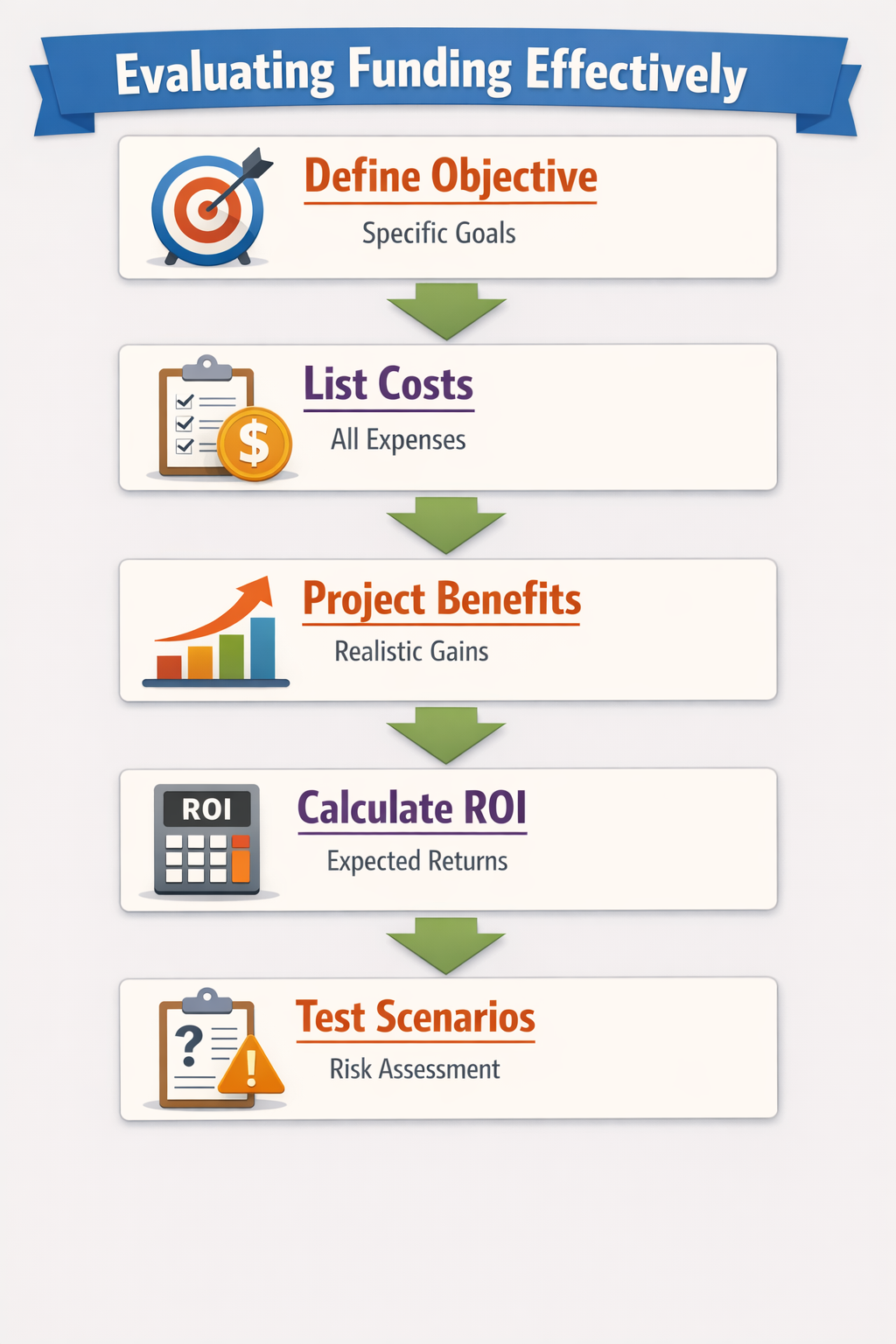
A step-by-step process for funding evaluation helps you work through the analysis systematically. Following a structured approach reduces the chance of overlooking important factors.
- Define your specific objective: Write down exactly what you intend to accomplish with the funding. Vague goals like growing the business don't provide enough direction. Instead, specify outcomes such as increasing production capacity by 30 percent or entering two new regional markets.
- List all associated costs: Document every expense connected to obtaining and using the capital. Include obvious items like interest and fees, plus less visible costs like time spent on applications, consultant fees, or operational adjustments needed to support growth.
- Project realistic benefits: Estimate the financial gains based on your industry experience and market research. Use conservative assumptions rather than best-case scenarios. If historical data shows 15 percent growth in similar situations, don't project 40 percent without solid justification.
- Calculate your expected ROI: Use the formula that compares net benefits to costs. Divide the expected gain by the total investment to get a percentage return. Compare this figure to your cost of capital and industry benchmarks to determine if the opportunity meets your threshold.
- Test different scenarios: Run your calculations under optimistic, realistic, and pessimistic conditions. If funding only works out when everything goes perfectly, it might be too risky. Ideally, even your conservative scenario should show acceptable returns.
How to Determine If Funding Will Actually Help Your Business
How to determine if funding will actually help your business ultimately comes down to matching capital with clear opportunity. When the numbers support your projections and the strategy aligns with your goals, funding can accelerate growth.
- Match funding type to business need: Different situations call for different financing structures. Short-term working capital needs might suit one type of advance, while equipment purchases might benefit from another approach. Understanding which funding option fits your specific circumstance improves outcomes.
- Verify your capacity to repay: Look at your cash flow projections and ensure you can comfortably meet repayment obligations. Funding that strains your finances creates stress and limits flexibility. Your revenue should support repayment even if some customers pay late or sales dip slightly.
- Evaluate the full cost structure: Compare multiple funding sources by calculating the total cost over the entire term. Some options appear cheaper initially but carry back-end costs that add up. Others have higher upfront costs but fewer surprises. Transparent comparison prevents costly mistakes.
- Assess implementation requirements: Determine what needs to happen operationally to make the investment successful. If you're funding inventory, do you have the storage space and sales channels ready? If it's equipment, is your staff trained to use it effectively? Execution capacity matters as much as capital availability.
Making smart funding decisions protects your business while opening doors to growth. By applying cost benefit analysis, calculating ROI carefully, and ensuring strategic fit, you can separate opportunities that truly advance your goals from those that simply add financial burden.
The key is approaching each funding opportunity with clear eyes and systematic evaluation. When you take time to understand the complete cost structure, project realistic returns, and confirm alignment with your business strategy, you position yourself to make choices that strengthen rather than strain your operations.
Remember that not every funding opportunity is right for every business. Sometimes the best decision is to wait, pursue alternatives, or scale back your plans. What matters most is that you're making informed choices based on solid analysis rather than pressure or optimism alone.
At Trulo Capital, we understand that business owners need clarity when evaluating financing options. The right capital at the right time can transform your business, but only when it's deployed strategically with a clear path to positive returns.