
.png)

Growing your business often requires capital, but accessing funding doesn't mean you should risk your company's financial stability. Many merchants find themselves in tough situations when they take on more debt than their cash flow can handle. The good news? You can fuel expansion without putting everything on the line.
Understanding the top 7 ways to use funding without overleveraging helps you make smarter decisions about your business's future. With the right approach, you'll maintain control over your operations while building toward sustainable success. Financial discipline and risk awareness aren't just buzzwords, they're the foundation of controlled growth that lasts.
Let's explore practical strategies that help you leverage capital responsibly, protect your ownership, and keep your business on solid financial ground.
Choose Non-Dilutive Funding Options
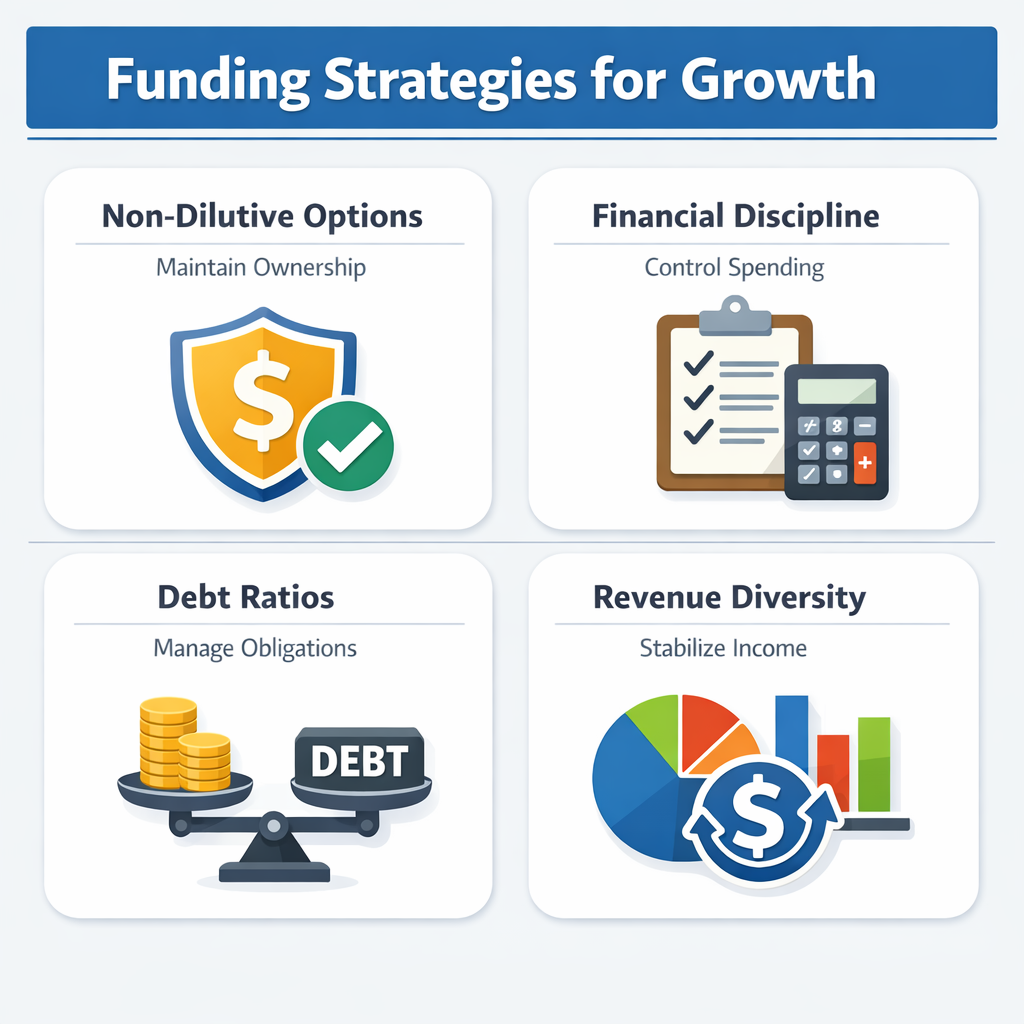
Choosing non-dilutive funding options helps you access the capital you need while maintaining full ownership of your business. Unlike equity financing, these alternatives don't require you to give up shares or control to outside investors.
- Revenue-based financing: This option allows you to repay funding as a percentage of monthly revenue, which means payments adjust based on your cash flow. During slower months, you'll pay less, reducing financial strain.
- Crowdfunding platforms: By raising capital from multiple small contributors, you can fund specific projects or expansion efforts without sacrificing equity or taking on traditional debt obligations.
- Strategic partnerships: Forming alliances with complementary businesses might provide access to resources, capital, or shared expenses that support growth without formal financing arrangements.
- Merchant cash advances: These provide quick access to working capital based on future sales, with repayment tied to daily revenue rather than fixed monthly installments.
Non-dilutive funding tends to preserve your decision-making authority while still providing the resources necessary for expansion. This approach supports controlled growth by aligning repayment with your business's actual performance rather than fixed obligations that could strain cash flow during lean periods.
Implement Strong Financial Discipline Practices
Implementing strong financial discipline practices forms the backbone of responsible funding use and helps prevent overleveraging. When you maintain tight control over your finances, you're better positioned to manage capital effectively and avoid unnecessary risks.
- Create detailed budgets: Develop comprehensive spending plans that account for all operational costs, debt service, and growth investments. Regular budget reviews help you spot potential issues before they become problems.
- Monitor cash flow consistently: Track money moving in and out of your business daily or weekly. This visibility allows you to make informed decisions about when to deploy funding and when to hold back.
- Separate growth capital from operating funds: Keep funding designated for expansion in separate accounts from day-to-day operational money. This practice prevents accidental overspending and maintains clarity about resource allocation.
- Set spending thresholds: Establish clear limits for different expense categories and require approval processes for purchases above certain amounts. This structure encourages mindful spending across your organization.
Financial discipline might seem restrictive at first, but it actually creates freedom by ensuring your business operates within sustainable parameters. Strong fiscal management enhances your funding prospects because lenders and investors typically favor businesses that demonstrate responsible resource stewardship.
Evaluate Debt Service Coverage Ratios
Evaluating debt service coverage ratios helps you understand whether your business can comfortably handle its debt obligations. This metric compares your operating income to your total debt payments, providing a clear picture of financial health.
- Calculate your ratio regularly: Divide your net operating income by total debt service to determine your coverage ratio. A ratio above 1.25 typically indicates healthy capacity to manage debt obligations.
- Factor in growth investments: When considering new funding, project how additional debt service will impact your ratio. This forward-looking approach helps you avoid taking on more than your cash flow can support.
- Maintain comfortable margins: Aim to keep your debt service below a defined threshold of your revenue, often suggested at around 30-40% of gross income. This cushion protects against unexpected downturns or slower sales periods.
- Review before major decisions: Check your debt service coverage before committing to expansion plans, new equipment purchases, or additional funding rounds. This habit supports risk awareness by revealing potential strain points.
Understanding your debt service capacity allows you to scale operations without endangering your business's viability. By keeping debt obligations aligned with cash flow capabilities, you preserve flexibility to respond to market changes and maintain operations during challenging periods.
Strategic Ways to Deploy Funding for Maximum Impact
Deploying funding strategically ensures every dollar works toward sustainable growth rather than creating unnecessary financial burden. The following numbered approaches help you allocate capital in ways that support controlled expansion.
- Invest in revenue-generating activities first: Prioritize funding uses that directly increase sales or improve margins, such as marketing campaigns with proven returns, inventory for high-demand products, or sales team expansion. These investments may help your business generate the cash flow needed to service debt comfortably.
- Upgrade operational efficiency: Use capital to eliminate bottlenecks or automate repetitive tasks that drain resources. Technology improvements, process optimization, or equipment upgrades often reduce long-term costs while increasing capacity, creating a better foundation for growth.
- Build working capital reserves: Set aside a portion of funding as a financial cushion for unexpected expenses or seasonal fluctuations. This buffer reduces the temptation to take on additional debt during temporary cash flow gaps, supporting disciplined spending habits.
- Time large expenditures carefully: Spread major investments across quarters rather than making multiple large purchases simultaneously. This pacing approach helps you assess the impact of each investment before committing to the next, reducing the risk of overextension.
- Test before scaling: When funding expansion into new markets or product lines, start with smaller pilot programs. This measured approach allows you to validate assumptions and adjust strategies before committing substantial resources.
Strategic deployment transforms funding from a potential liability into a growth accelerator. Each investment decision should connect clearly to measurable business outcomes that improve your ability to meet financial obligations while expanding your market presence.
Maintain Diverse Revenue Streams
Maintaining diverse revenue streams protects your business from overleveraging by ensuring income stability across different sources. When you rely on multiple channels, a downturn in one area doesn't threaten your entire operation or your ability to service debt.
- Develop complementary product lines: Expand your offerings to serve different customer needs or price points within your core market. This diversification can smooth revenue fluctuations while leveraging your existing customer relationships and operational capabilities.
- Explore multiple sales channels: Balance direct sales with wholesale partnerships, online platforms, or subscription models. Each channel might perform differently during various economic conditions, creating more predictable overall cash flow.
- Cultivate repeat business programs: Implement loyalty initiatives, service contracts, or recurring revenue models that generate predictable income. This steady cash flow makes it easier to plan debt service and reduces dependence on new customer acquisition.
- Assess seasonal balance: If your business experiences seasonal peaks, consider adding products or services that perform well during your slower periods. This balancing act helps maintain consistent revenue that supports debt obligations year-round.
Revenue diversification isn't about chasing every opportunity, it's about creating stability that allows you to use business funding effectively. When you know income will continue from multiple sources, you can invest in growth without the fear that a single market shift will leave you unable to meet financial commitments.
The Foundation of Sustainable Scaling
The foundation of sustainable scaling rests on balancing ambition with financial prudence. When you understand the top 7 ways to use funding without overleveraging, you're equipped to pursue growth opportunities while protecting your business's long-term viability.
Smart merchants recognize that rapid expansion fueled by excessive debt often creates more problems than it solves. By contrast, controlled growth supported by appropriate funding levels, disciplined spending, and strong risk awareness typically leads to lasting success. Your business gains the strength to weather economic uncertainty while continuing to move forward.
Think of responsible funding use as building a house with a solid foundation rather than a tall structure on unstable ground. Each decision to deploy capital wisely reinforces your business's stability and creates capacity for future opportunities. This measured approach might feel slower than aggressive leveraging, but it tends to produce results that endure beyond short-term gains.
Growing your business requires capital, but it shouldn't require compromising your financial security. The top 7 ways to use funding without overleveraging provide a roadmap for expansion that protects what you've built while reaching for what's possible.
By choosing non-dilutive funding options, you maintain ownership and control. Implementing strong financial discipline ensures every dollar serves a purpose. Evaluating debt service coverage keeps obligations aligned with capacity. Strategic deployment maximizes impact, while diverse revenue streams provide stability. Together, these approaches create a framework for controlled growth that stands the test of time.
Remember, sustainable success isn't about how quickly you can scale, it's about building a business that thrives for years to come. With disciplined spending, risk awareness, and smart capital deployment, you can achieve the growth you envision without putting everything on the line. Start applying these principles today, and you'll position your business for a future defined by stability, profitability, and lasting impact.